Evidence and Research
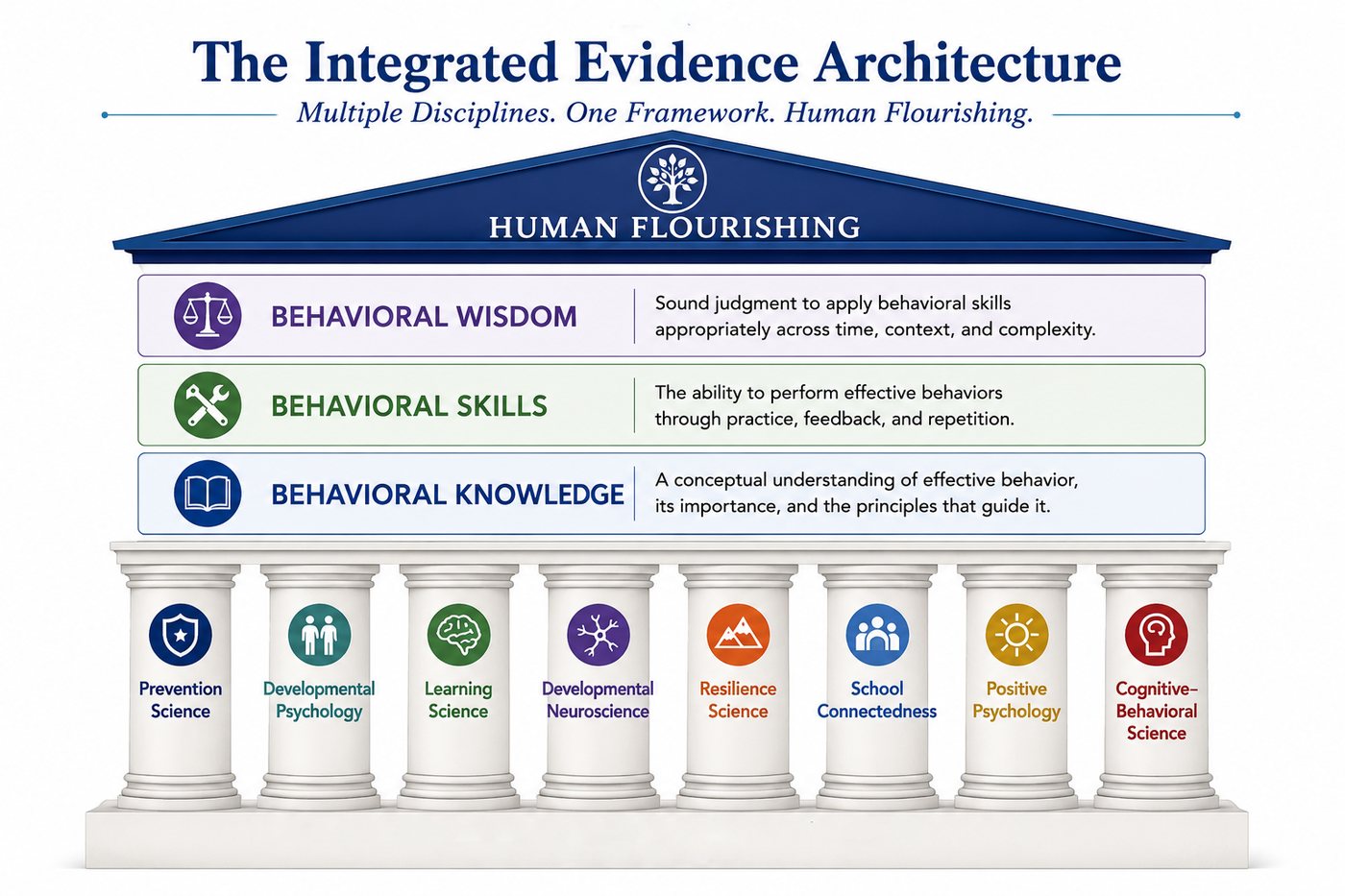
LifeBST does not rest on a single theory or a proprietary program. It rests on the convergence of eight established scientific disciplines, each with decades of peer-reviewed research behind it, and each arriving independently at the same conclusion: behavioral skills can be taught, they develop across childhood and adolescence, and strengthening them early improves long-term outcomes.
That convergence is the argument. No individual study validates a framework this broad, and LifeBST does not claim one does. Confidence comes instead from many independent fields pointing the same direction. What follows names the landmark findings behind each, so the claim can be examined rather than simply accepted.
Eight disciplines, one conclusion
Prevention science. The foundational distinction in prevention research is between treating conditions that already exist and reducing risk before onset. The landmark Institute of Medicine report established that strengthening protective factors before problems emerge is both more effective and more efficient than responding after the fact.1 That is the entire logic of a Tier 1 universal approach.
Learning science. How skills are acquired and retained is among the most thoroughly studied questions in education. Feedback is one of the most powerful influences on achievement ever identified;2 retrieval practice substantially improves long-term retention;3 distributed practice outperforms massed instruction;4 and deliberate, structured practice is what converts knowledge into competence.5 The Knowledge → Skills → Wisdom progression is built on these mechanisms.
Developmental psychology. Behavioral capacities are not fixed traits. Self-regulation follows a documented developmental trajectory,6 and executive functions — the capacities underlying self-control, planning and flexible thinking — develop measurably through childhood and adolescence.7 This is why instruction is sequenced developmentally rather than delivered once.
Developmental neuroscience. The developing brain is shaped by experience. Learning a new skill produces measurable structural change in the brain,8 and the adolescent brain remains highly plastic during exactly the years schooling reaches students.9 Behavioral skill-building is literally brain-building.
Resilience science. More than four decades of longitudinal work, including landmark studies that followed high-risk children into adulthood,10 establish that resilience arises not from rare traits but from ordinary, strengthenable protective factors.11 Resilience is buildable, and that is not a hopeful assumption but a research finding.
School connectedness. Among the most consistently documented protective factors in a young person’s life is the sense of belonging at school. The national study of adolescent health identified it as a powerful protector against a wide range of health-risk behaviors;12 longitudinal research links early school connectedness to better mental health, lower substance use and stronger academic outcomes years later.13
Positive psychology. The scientific study of well-being, as distinct from the absence of dysfunction, was formally established at the turn of the century14 and has produced a substantial evidence base on character strengths, purpose and flourishing. LifeBST’s orientation toward flourishing rather than mere problem-avoidance rests on this work.
Cognitive-behavioral science. The relationships among thoughts, emotions and behaviors, and the ways reflection and practice strengthen judgment, are among the most extensively validated findings in psychology — from the classic research on judgment and cognitive bias forward.15 The emphasis on reflection and behavioral wisdom draws directly on it.
Does teaching these skills in school actually work?
That is the question a superintendent will ask, and it has a direct answer from large-scale meta-analysis rather than from theory.
A meta-analysis of 213 school-based universal social-emotional learning programs, involving more than 270,000 students, found significant improvements in social-emotional skills, attitudes, behavior and academic achievement — including an eleven-percentile-point gain in academic performance among participating students.16 A follow-up meta-analysis found these benefits persist, with effects on well-being and reduced conduct problems measurable months and years after the programs ended.17
LifeBST is broader and more developmentally comprehensive than a typical SEL program, so this is not evidence for LifeBST specifically. It is evidence for its central premise: that teaching these skills, universally and in school, produces durable and measurable benefit.
What the research establishes
- Behavioral skills are teachable, not fixed. They can be strengthened through instruction, practice and feedback.5,2
- The K–12 years are a window of opportunity. Cognitive, emotional and behavioral capacities — and the brain itself — are actively developing during exactly the years schools reach students.7,8,6
- Prevention works better than reaction. Strengthening protective factors before problems emerge is more effective and more efficient than responding after crisis.1,11
- Universal school-based skill instruction produces measurable, lasting outcomes.16,17
The need
National surveillance data show rising rates of mental, behavioral and developmental difficulties among children and adolescents.18 In the CDC’s 2023 Youth Risk Behavior Survey, 20.4% of US high school students seriously considered attempting suicide in the preceding year.19
Self-harming behavior is more common than many educators and families realize, and more common than suicidal behavior. A meta-analysis of 686,672 children and adolescents found a lifetime prevalence of non-suicidal self-injury of approximately 22% — several times higher than the roughly 6% rate of suicide attempts — and frequently signalling serious emotional distress even where there is no suicidal intent.20 Other recent meta-analyses put adolescent lifetime prevalence somewhat lower, near 18%.21 The estimates vary with method and population; the order of magnitude does not.
Why the timing matters
Something happens to a child. Whether an adult looking on would call it trauma is beside the point; what matters is whether it was trauma to the child who lived it. The child adapts as best they can, and the adaptation is usually invisible. It goes underground through the elementary years and surfaces at twelve, thirteen, fourteen, carrying everything that grew in the dark.
By the time a behavior is visible enough for a school to act on, the pattern beneath it is years old. That is not a failure of the people responding, and responding faster does not solve it. It is a problem of timing.
Teaching earlier does address it — before there is anything to respond to, to every child rather than to the ones who will later turn out to have needed it most. Schools are the only institution that reaches nearly every child through the whole of that window. That is the argument for a K–12 framework rather than a single intervention delivered at the age the trouble becomes visible.
Schools have responded with counseling, crisis intervention, disciplinary systems and referrals. Those services are essential and deserve continued investment. They share one limitation: they are designed to respond after a problem has already emerged. That is the gap LifeBST is built to fill — not by replacing any of it, but by strengthening the universal foundation underneath.
What we do not claim
LifeBST has not been through its own randomized trial. Its component disciplines are extensively established; the framework itself is an integration of them, offered for implementation and rigorous evaluation.
Statements anywhere on this site about what LifeBST will achieve are projections — anticipated results of applying well-supported science — and are to be confirmed through measurement rather than assumed. Implementation should be paired with evaluation across behavioral, relational, academic and well-being outcomes, and that evaluation should be allowed to change the framework.
We would rather be held to that standard than to a stronger claim we cannot yet support.
Notes
- Mrazek, P. J., & Haggerty, R. J. (Eds.). (1994). Reducing Risks for Mental Disorders: Frontiers for Preventive Intervention Research. National Academies Press.
- Hattie, J., & Timperley, H. (2007). The power of feedback. Review of Educational Research, 77(1), 81–112.
- Roediger, H. L., III, & Karpicke, J. D. (2006). Test-enhanced learning: Taking memory tests improves long-term retention. Psychological Science, 17(3), 249–255.
- Cepeda, N. J., Pashler, H., Vul, E., Wixted, J. T., & Rohrer, D. (2006). Distributed practice in verbal recall tasks: A review and quantitative synthesis. Psychological Bulletin, 132(3), 354–380.
- Ericsson, K. A., Krampe, R. T., & Tesch-Römer, C. (1993). The role of deliberate practice in the acquisition of expert performance. Psychological Review, 100(3), 363–406.
- Blair, C., & Raver, C. C. (2015). School readiness and self-regulation: A developmental psychobiological approach. Annual Review of Psychology, 66, 711–731.
- Diamond, A. (2013). Executive functions. Annual Review of Psychology, 64, 135–168.
- Draganski, B., Gaser, C., Busch, V., Schuierer, G., Bogdahn, U., & May, A. (2004). Neuroplasticity: Changes in grey matter induced by training. Nature, 427, 311–312.
- Blakemore, S.-J. (2008). The social brain in adolescence. Nature Reviews Neuroscience, 9, 267–277.
- Werner, E. E., & Smith, R. S. (1992). Overcoming the Odds: High Risk Children from Birth to Adulthood. Cornell University Press.
- Masten, A. S. (2001). Ordinary magic: Resilience processes in development. American Psychologist, 56(3), 227–238.
- Resnick, M. D., Bearman, P. S., Blum, R. W., et al. (1997). Protecting adolescents from harm: Findings from the National Longitudinal Study on Adolescent Health. JAMA, 278(10), 823–832.
- Bond, L., Butler, H., Thomas, L., Carlin, J., Glover, S., Bowes, G., & Patton, G. (2007). Social and school connectedness in early secondary school as predictors of late teenage substance use, mental health, and academic outcomes. Journal of Adolescent Health, 40(4), 357.e9–357.e18.
- Seligman, M. E. P., & Csikszentmihalyi, M. (2000). Positive psychology: An introduction. American Psychologist, 55(1), 5–14.
- Tversky, A., & Kahneman, D. (1974). Judgment under uncertainty: Heuristics and biases. Science, 185(4157), 1124–1131.
- Durlak, J. A., Weissberg, R. P., Dymnicki, A. B., Taylor, R. D., & Schellinger, K. B. (2011). The impact of enhancing students’ social and emotional learning: A meta-analysis of school-based universal interventions. Child Development, 82(1), 405–432.
- Taylor, R. D., Oberle, E., Durlak, J. A., & Weissberg, R. P. (2017). Promoting positive youth development through school-based social and emotional learning interventions: A meta-analysis of follow-up effects. Child Development, 88(4), 1156–1171.
- Leeb, R. T., et al. (2024). Trends in mental, behavioral, and developmental disorders among children and adolescents in the U.S., 2016–2021. Preventing Chronic Disease, 21, E71.
- Centers for Disease Control and Prevention. Youth Risk Behavior Survey Data Summary & Trends Report, 2023. See also Verlenden, J. V., et al. (2024). Mental health and suicide risk among high school students and protective factors. MMWR Supplements, 73(4).
- Lim, K.-S., Wong, C. H., McIntyre, R. S., et al. (2019). Global lifetime and 12-month prevalence of suicidal behavior, deliberate self-harm and non-suicidal self-injury in children and adolescents between 1989 and 2018: A meta-analysis. International Journal of Environmental Research and Public Health, 16(22), 4581.
- Farkas, B. F., et al. (2023). The prevalence of self-injury in adolescence: A systematic review and meta-analysis. European Child & Adolescent Psychiatry.