The Foundation of Faith
LifeBST is being developed first in a secular edition, grounded in its scientific foundations, so that any school — public, private, or home — can use it without adopting anyone’s convictions. Beneath it lies a further layer: the convictions the work was built on. A faith-based version, which names that foundation explicitly, is in development.
One framework, many versions
The framework is intended to support a family of versions — the secular edition being written now, a faith-based version in development, and versions anticipated for community organizations, the military, and veterans. The framework does not change between them. The developmental sequence, the Knowledge → Skills → Wisdom progression, the eight scientific disciplines and the instructional method stay the same. What differs is the setting, the vocabulary, and whether the foundation beneath them is named.
That distinction will matter in both directions. A public school adopting the secular edition is not receiving a religious curriculum with the religion filed off; it is receiving the framework as the science supports it. A Christian school adopting the faith-based version will not be receiving a secular program with verses attached; it will be receiving the same framework with the convictions that produced it made explicit.
Why the foundation sits below ground
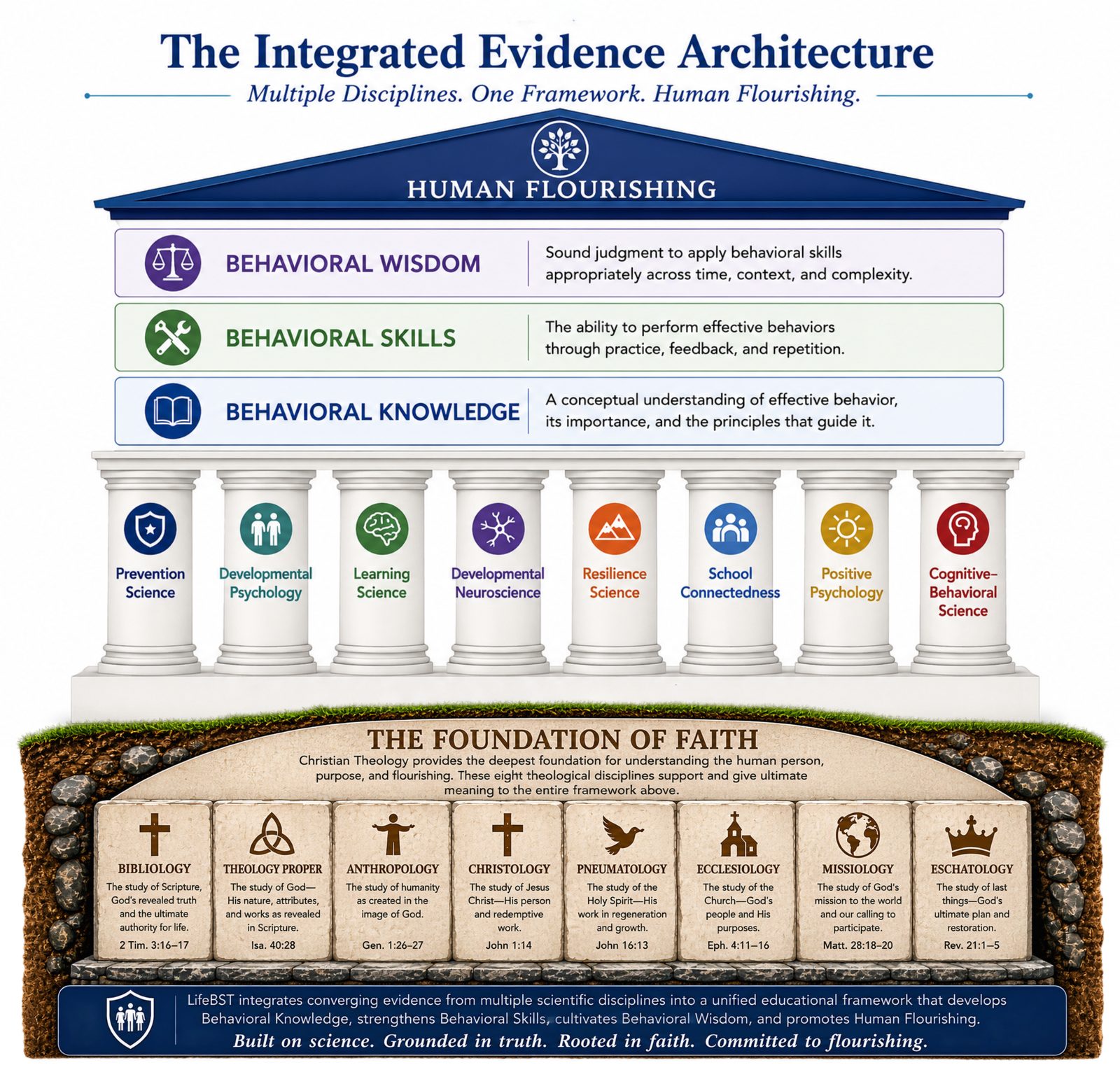
In the diagram above, the theological disciplines are drawn beneath the surface. That placement is the argument, not decoration.
A foundation is not what a building is for, and it is not usually visible. It is what everything else stands on. The eight sciences carry real structural load and are true on their own terms — prevention science does not need theology to establish that early intervention works, and resilience research would report what it reports whether or not anyone prayed over it. None of the columns are derived from the foundation. That independence is precisely what makes the secular edition honest rather than incomplete.
What the foundation supplies is not evidence but meaning: an answer to why a child is worth this trouble, what a person is for, and what flourishing ultimately consists of. Science can establish that behavioral skills are teachable and that teaching them improves lives. It cannot, by itself, say why a life is worth improving. For Families Renewed, that answer comes from Christian theology.
The eight theological disciplines
Christian theology provides the deepest foundation for understanding the human person, purpose, and flourishing. Eight theological disciplines support and give ultimate meaning to the framework above.
- Bibliology — the study of Scripture, God’s revealed truth and the ultimate authority for life.
- Theology Proper — the study of God: His nature, attributes, and works as revealed in Scripture.
- Anthropology — the study of humanity as created in the image of God.
- Christology — the study of Jesus Christ, His person and redemptive work.
- Pneumatology — the study of the Holy Spirit, His work in regeneration and growth.
- Ecclesiology — the study of the Church, God’s people and His purposes.
- Missiology — the study of God’s mission to the world and our calling to participate.
- Eschatology — the study of last things, God’s ultimate plan and restoration.
Anthropology is the load-bearing one for this work. If every child is made in the image of God, then no child is a lost cause, no child is beneath the effort, and the behavioral capacity of a struggling twelve-year-old is worth years of patient instruction. The framework’s insistence that it is universal — for every student, not only those already in difficulty — follows from that conviction as much as from prevention science.
For faith-based schools, churches, and families
Christian schools are frequently asked to form character and are rarely given a structure for doing it. LifeBST offers one: a developmental sequence, an instructional method, and a scientific basis that will withstand scrutiny from an accreditor, sitting on a foundation the school already holds.
For churches and youth ministries, the same framework applies outside the classroom. Behavioral skills are taught the same way whether the setting is a school day, a youth group, or a family table — through instruction, modeling, practice, feedback, and reflection.
For families teaching at home, the faith edition removes an artificial separation. Parents already teach behavior and belief together. There is no reason a curriculum should force them apart.
What this does not mean
- It does not change the science. The eight disciplines, their findings, and the evidence for universal behavioral instruction are the same in both editions and stand on their own.
- It is not what a public school receives. The secular edition is the default and is complete in itself. No public school adopting LifeBST receives theological content.
- It is not evangelism dressed as curriculum. Behavioral skills instruction is behavioral skills instruction. The foundation explains why the work is undertaken; it does not convert the lessons into something else.
Families Renewed, Inc. anticipates releasing further values-aligned editions for communities that wish to situate behavioral education within their own traditions. The framework beneath them all remains the same.